

tempRCORE™ by Pyrophobic Systems is engineered to outperform traditional wood and mineral fire-rated door cores. With its advanced mineral formulation, tempRCORE™ offers unmatched fire resistance, lighter weight, and superior durability—making it the smarter choice for high-performance commercial door systems.
Introduction: The Hidden Weakness Behind Many Fire-Rated Doors
OEM Engineers know that fire-rated doors are more than a checkbox in the specification manual, they’re critical life-safety systems. But when fires hit 1,000°F and doors are expected to hold for 90 minutes or more, not all door cores are built for the job.
Many commercial doors still rely on legacy core designs, such as wood-based particleboard, traditional mineral core, and even honeycomb or steel-stiffened (ribbed) metal cores. While each serves specific architectural purposes, many struggle to meet the full spectrum of today’s fire performance, smoke containment, and structural integrity expectations under UL 10C or NFPA 252 test conditions.”
This is where tempRCORE™ from Pyrophobic Systems sets a new benchmark: a UL 10C certified, fiberglass-reinforced mineral core engineered for 1.5 and 3-hour fire-rated steel doors. Let’s explore why tempRCORE™ is becoming the new industry standard.
Why Fire Door Certifications Matter for OEMs
For OEM engineers, compliance isn’t just a regulatory hurdle; it’s a competitive advantage. Certifications like UL 10C, NFPA 252, UL 1784, and ULC CAN4-S104-M80 are vital because they validate a fire-rated door’s real-world performance under extreme conditions, fire exposure, pressure differentials, and smoke migration. Specifying cores that meet these standards reduces liability, accelerates Authority Having Jurisdiction (AHJ) approvals, and simplifies listing submissions through Intertek, UL, or WHI. tempRCORE™ empowers OEMs to meet these requirements with confidence, without the need for secondary blocking or workarounds, helping teams build safer doors, faster.
Core Comparisons: Wood, Mineral & tempRCORE™
Comparison of fire-rated door cores: particleboard, traditional mineral core, and tempRCORE™ .
| Property | Particleboard / Agrifiber | Traditional Mineral Core | Honeycomb / Steel Rib | tempRCORE™ (Pyrophobic) |
|---|---|---|---|---|
| Fire Rating | 20–60 mins | Up to 90 mins | Variable (up to 90 mins) | Up to 3 hours (UL 10C) |
| Smoke Containment | Weak (non-sealing) | Moderate | Weak (non-sealing) | UL 1784 Certified |
| Positive/Negative Pressure | Rare | Partial | Not rated | UL 10C , NFPA 252 Tested |
| Screw Retention | Poor | Moderate | Variable | 150 psi tensile strength |
| Reinforcement Needed | Yes | Often | Often (blocking or stiffeners) | None required |
| Certifications | Some UL ratings | Limited assemblies | Non-uniform across manufacturers | Full suite: UL, WHI, ULC |
Why Wood Cores Aren’t Enough for Today’s Fire Doors
Wood-based door cores like particleboard, agrifiber, or stave core are common in 20- and 45-minute doors. They’re affordable and lightweight, but present serious challenges in higher ratings.
Problems OEMs Face with Wood Door Cores:
- Low resistance to heat and flame spread
- Inadequate smoke containment, risking building code failure
The Problem with Honeycomb and Steel Rib Cores
While honeycomb and steel stiffened cores are widely used in architectural doors for their lightweight or high-impact properties, they often fall short in critical fire protection benchmarks:
- Honeycomb cores, typically made from kraft paper or steel, can collapse under high heat due to a lack of fire-resistive fillers.
- Steel ribbed doors offer physical durability but require heavy gauge reinforcement and added fire barriers to meet stringent UL 10C and smoke containment ratings.
- Neither design consistently delivers the integrated thermal insulation, temperature rise limits, or smoke protection needed for modern commercial fire doors.
tempRCORE™ eliminates this compromise by integrating structural strength and temperature rise performance in a single core.
The tempRCORE™ Advantage: Firepower Meets Flexibility
tempRCORE™ is not just a mineral core, it’s an engineered composite system that integrates thermal insulation and mechanical stability. Unlike traditional cores that rely on layered materials (e.g., wood, mineral boards, steel stiffeners, or honeycomb paper), tempRCORE™ uses a proprietary formulation reinforced with fiberglass, offering a monolithic structure that resists delamination, controls temperature rise and maintains hardware anchorage under heat.
This results in:
- Superior fire and smoke performance (UL 10C and UL 1784 compliant).
- No need for internal blocking or reinforcements.
- Consistent performance across large and complex door configurations.
- Lower installation variability and higher reliability across OEM lines.
Certified Performance That Exceeds Industry Benchmarks
| Test Standard | Applies To | Purpose | tempRCORE™ Status |
|---|---|---|---|
| UL 10C | Positive/Negative Pressure Fire Doors | Simulates real fire exposure, including air pressure differences across the door | ✅ Passed (1.5 & 3-hour rated) |
| NFPA 252 | Fire Door Assemblies | Measures ability of complete door assembly to resist fire | ✅ Approved for full door systems |
| UL 1784 | Smoke Leakage | Evaluates how well the door core prevents smoke penetration | ✅ Certified for smoke containment |
| UBC 7-2 Part I | Temperature Rise | Limits the temperature on the unexposed side during a fire | ✅ 250°F at 30 mins (US rating) |
| ULC CAN4-S104-M80 | Canadian Fire Resistance | Canadian equivalent of UL 10C & NFPA tests for fire-resistive assemblies | ✅ Compliant (250°C @ 60 mins) |
Built for Versatile OEM Door Design
tempRCORE™ supports the most common commercial configurations:
- Single Steel Doors: up to 4′ × 8′.
- Standard Double Doors: up to 8′ × 8′ (requires astragal for listing compliance).
- Double-Egress Pairs: up to 8′ × 8′ with vertical rods, fire exit hardware & astragal.
- Vision Panels: maximum 100 sq in, typically up to 5″ × 20″ glaze size.
- Steel Skins Supported: flush steel, 20‑gauge to 16‑gauge.
- Core Jointing: up to 3 panels per door (e.g., vertical/horizontal butt joints).
- Thickness (core panel): standard at 1.656″ (42 mm); overall door thickness 1¾″.
- Weight/Density: ~55 lb per core; 21–24 lb/ft³ density.
- Tensile Strength: ~150 psi core retention strength.
tempRCORE™ can support engineered alternatives, subject to testing and engineering review:
- Oversized doors beyond 4′×8′ single or 8′×8′ pair.
- Higher gauge skins (e.g. 14‑gauge or 18‑gauge steel) under special-engineered conditions.
- Custom hardware configurations including top/bottom vision lites, sidelites, transoms, or multiple glazing.
- Acoustic-rated assemblies or lead-lined cores, especially for healthcare or high-security installations.
These require custom UL fire labeling or submittal reviews.
| Mode / Feature | Standard Listed Limit | Custom Capabilities (with review/testing) |
|---|---|---|
| Single Doors | Up to 4′×8′ | Oversized single doors possible |
| Standard Double Doors | Up to 8′×8′ (with astragal) | Doors >8′ possible with engineering approval |
| Double Egress Doors | Up to 8′×8′ with vertical rods & hardware | Higher dimensions or alternate rod systems possible |
| Vision Panels | Max 100 in² (e.g. 5″×20″) | Custom glazing layouts under review |
| Steel Skin Gauge | Flush skins, 20–16 gauge | 14 or higher gauge possible with customization |
| Core Panel Thickness | 1.656″ standard | Adjustable per spec |
| Jointing | Max 3 core panels per door | Special larger cores possible |
| Hardware Anchoring | Supports standard ANSI‑A115 hardware | Custom anchor patterns feasible |
tempRCORE™ is certified for standard configurations up to 4′ × 8′ single doors, up to 8′ × 8′ standard and egress double doors (with declared vision lites and skin gauges). While these represent typical tested limits, custom configurations, such as oversized doors, higher gauge skins, sidelites, or acoustic/lead-lined doors, are available upon engineering review and additional fire-label testing.
A Smarter Specification for OEM Engineers
tempRCORE™ helps OEMs meet and exceed:
- ASTM E119 fire resistance rating
- UL 1479 / ASTM E814 tested
- Building code firestop material requirements
It also simplifies production:
- No blocking
- High screw retention
Works with all approved door hardware
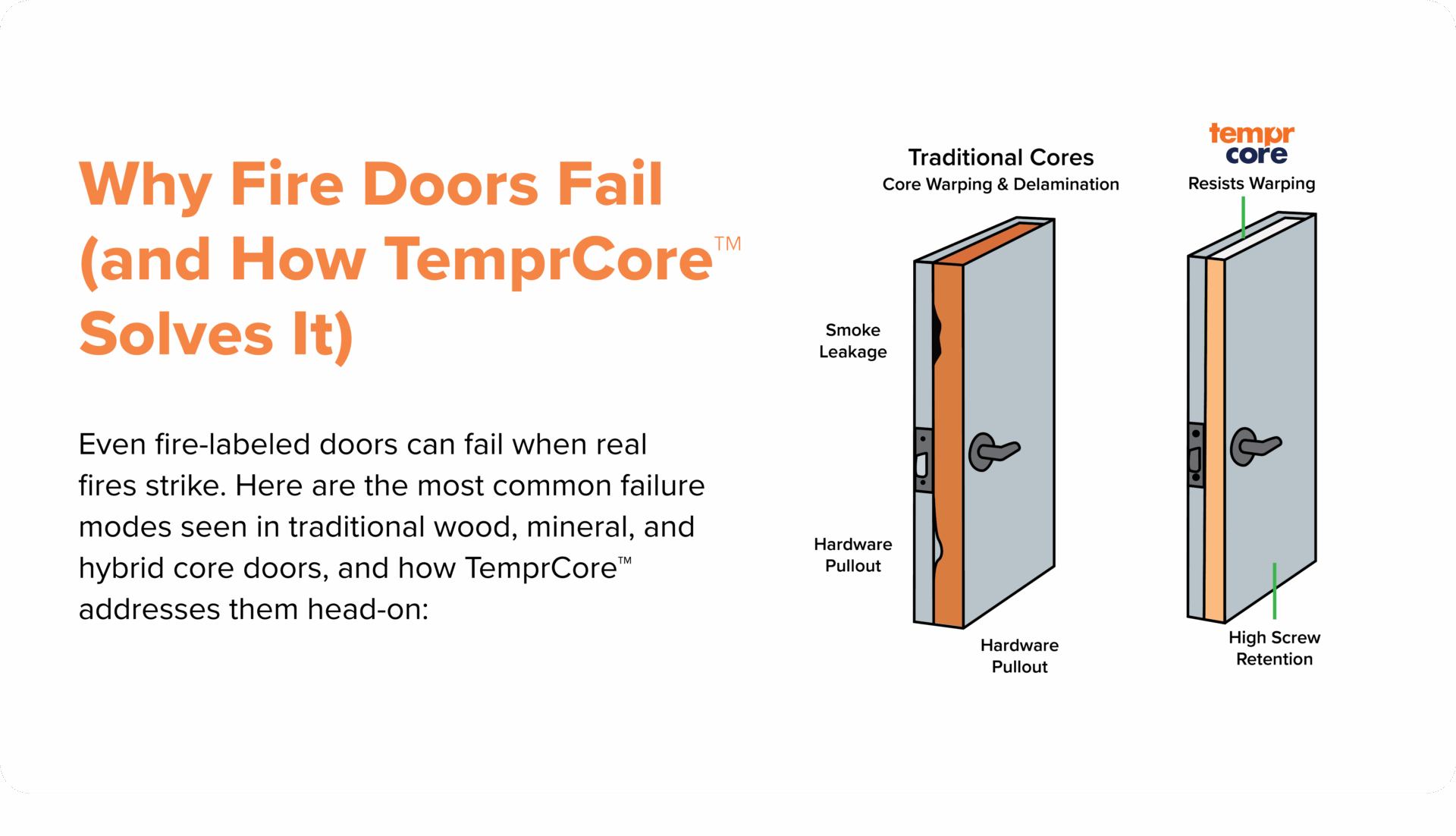
| Common Failure Mode | Cause | tempRCORE™ Advantage |
|---|---|---|
| Core Warping & Delamination | Wood and layered mineral boards absorb moisture or lose cohesion under heat | Composite monolithic structure resists thermal deformation and moisture |
| Smoke Leakage | Poor integration between core and skin | UL 1784 certified |
| Hardware Pullout | Weak screw retention in particleboard/mineral core | 150 psi tensile screw retention, no blocking needed |
| Temperature Rise Failure | Non-insulated cores allow heat to transfer to safe side | 250°F @ 30 mins / 450°F @ 60 mins compliance (UBC 7-2) |
| Inconsistent Fire Ratings | Variability in multi-panel assemblies and edge blocking | Factory-controlled density and fiberglass reinforcement ensure uniformity |
Fire Door Core FAQs: Installation & Compatibility
Q: Can tempRCORE™ be used with panic hardware or fire exit devices?
A: Yes. tempRCORE™ has been tested and certified for use with standard panic hardware and fire exit devices, including vertical rod and rim exit systems. Its high screw retention (150 psi) eliminates the need for internal blocking.
Q: What steel skin gauges are compatible with tempRCORE™?
A: tempRCORE™ supports 20-gauge to 16-gauge steel skins in standard configurations. Heavier gauges (e.g. 14-gauge) may be possible in custom-engineered assemblies.
Q: Is tempRCORE™ compatible with double egress doors?
A: Yes. Double egress doors up to 8′ × 8′ with vertical rods and fire exit hardware are supported under UL and Warnock Hersey listings. Astragals may be required depending on swing direction and code requirements.
Q: Does tempRCORE™ meet smoke seal requirements for hospitals or schools?
A: Absolutely. tempRCORE™ is UL 1784 certified, meeting smoke and air leakage requirements required by IBC and NFPA 105 for healthcare, education, and commercial occupancies. When paired with compliant perimeter seals, it satisfies smoke partition ratings for corridor doors and cross-corridor egress.
Q: Does tempRCORE™ help with temperature rise compliance in rated doors?
A: Yes. tempRCORE™ is designed to meet strict temperature rise door requirements under UBC 7-2 and IBC Section 716, delivering 250°F @ 30 mins and 450°F @ 60 mins to help protect safe-side egress routes in stairwells and corridors.

Ready to Upgrade Your Core?
tempRCORE™ is built for OEM Engineers who demand performance, reliability, and code compliance.