Introduction: When AI Cooling Fails, Passive Fire Protection Decides the Blast Radius
AI data center cooling refers to the specialized thermal management systems designed to remove the intense heat produced by high-density artificial intelligence servers. Because AI workloads require powerful hardware that consumes significant amounts of electricity, these systems often rely on advanced cooling methods such as direct-to-chip liquid cooling or immersion cooling to maintain performance, prevent processor throttling, and protect equipment from overheating.
The AI cooling crisis is a risk-management gap, not just a thermal design challenge. As rack densities rise and direct liquid cooling becomes more common, data centers add more piping, more controls, and more penetrations through fire-rated walls and floors. Each penetration is a potential smoke and fire pathway if it is not protected by a tested firestop system.
For OEM engineers, this matters because your hardware choices shape the physical pathways a facility will use during a fault. When active cooling is stable, thermal risk often looks like throttling and alarming. In the event of an active cooling failure, the resulting heat can cause insulation to break down, connectors to degrade, and smoke to generate. At this critical point, the building’s infrastructure will either successfully contain the hazard or inadvertently allow it to spread.
Passive fire protection serves as a building’s continuous, always-on layer of defense. Because it functions independently of sensors, power, pumps, or human intervention, it is ready immediately. By utilizing fire-rated construction materials, compartmentation, and dedicated firestop systems, it effectively contains an incident to its area of origin, buying crucial time for emergency response and safe evacuation.
Passive fire protection for data centers is the built-in combination of rated walls and floors, compartmentation fire barriers, and UL 1479 / ASTM E814 tested firestop systems that contain fire and smoke without requiring external activation or power.
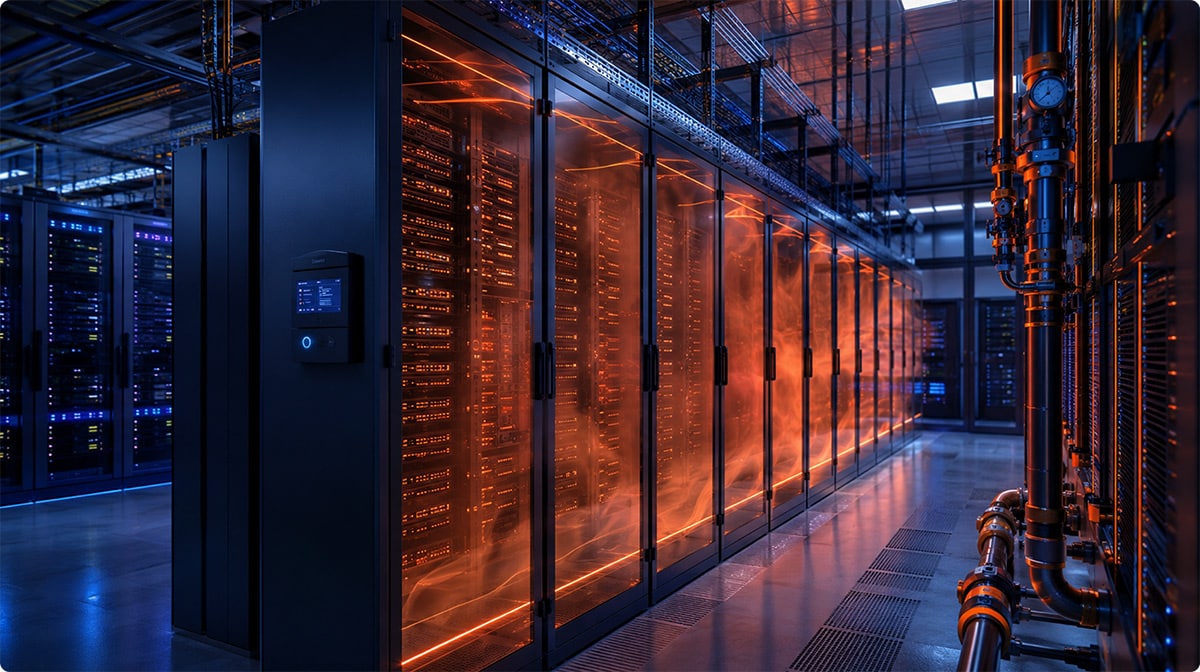
AI hot aisle containment concentrates extreme heat, and highlights why passive fire protection must limit smoke and fire pathways when cooling is compromised.
Industry Context and Root Causes
AI infrastructure increases both heat density and building interface complexity. That combination is why cooling failures now have outsized consequences. Higher density also tends to increase the number of services routed across compartments, which increases the number of penetration conditions to manage.
What Changed in Modern AI Halls:
- Higher power concentration: More compute per rack means a smaller thermal margin during any loss of flow or loss of air movement.
- More cooling interfaces: Direct liquid cooling introduces CDUs, manifolds, hoses, quick-connects, and leak detection, and it increases routing density.
- More penetrations through rated barriers: Liquid supply and return, busways, feeder whips, fiber, monitoring, and controls all need pathways, often across compartment boundaries.
Why Penetrations are the Quiet Failure Multiplier
Penetrations are where compartmentation becomes porous. Common penetration conditions in AI facilities include cable trays, cable bundles, conduits, sleeves, coolant piping, and floor or deck poke-through pathways. Each condition demands a specific firestop system listing. A tube of “firestop material” is not a compliance strategy. The system is what gets tested.
Material-Level Root Causes OEM Teams Often Miss
- Polymer shrink and gap formation: A part can pass a flammability screen and still shrink under sustained heat, opening a leakage path around a penetrant.
- Differential movement: Thermal cycling and building movement can fatigue seals, especially if a joint system is treated like a penetration system.
- Cable loading effects: Dense cabling changes geometry and increases smoke production during electrical faults, increasing the value of leakage control where required.
Safety, Performance, and Compliance Risks
Cooling failure is not automatically a fire event, but it can accelerate the conditions that produce smoke, arcing, and secondary ignition. In IT environments, smoke and heat can be as operationally damaging as flame, particularly when they migrate beyond the origin zone.
Safety Risks That Show Up First
- Smoke migration across zones: Unsealed penetrations can move smoke into adjacent halls, corridors, and egress routes.
- Loss of tenability: Smoke and heat reduce safe egress time and complicate response.
- Hidden fire spread: Fire can travel through voids and pathways long before it is visible in the origin room.
Performance Risks OEM Engineers Should Care About
- Cascading shutdowns: Smoke and particulates can trigger alarms and shutdowns beyond the origin zone, even when the heat source is localized.
- Maintenance and retrofit risk: Data centers change constantly, and every add and change is a chance to degrade passive fire protection if firestopping is not designed for re-entry.
- Inspection failure risk: A penetration that cannot be matched to a listed system becomes a documentation problem, then a schedule problem.

Compliance and Liability Risks
- Nonconforming installations: If the installed condition drifts from the UL 1479 / ASTM E814 listed configuration, you can fail inspection even when the intent was correct.
- Misapplied standards: Using a joint-system standard in a penetration context is a common failure mode.
- Supplier ambiguity: “Tested” is not the same as “listed system that matches this exact condition.”
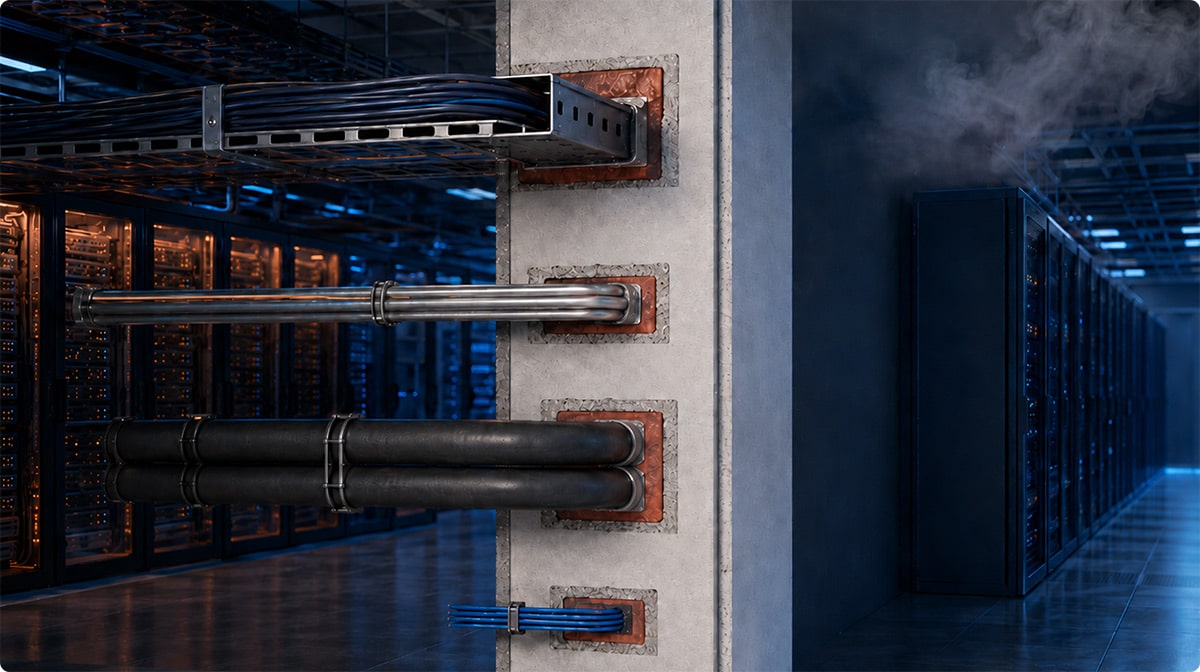
Compartmentation fire barriers only work when every MEP penetration is properly sealed to maintain smoke and fire containment.
Standards, Testing, and Regulatory Frameworks
Firestopping is governed by system tests, not generic material claims. The standards below are the practical backbone for building code fire compliance in mission-critical facilities. UL 1479 and ASTM E814 are core test methods used to evaluate through-penetration firestop systems. Results depend on the exact assembly tested, including penetrant type, size, and the wall or floor construction.
What Each Standard Governs, and Why OEMs Should Care
- UL 1479: Evaluates penetration firestop systems for openings in fire-resistive assemblies.
- ASTM E814: Evaluates penetration firestop system performance, including key rating criteria.
- ASTM E119: Evaluates fire resistance of building construction and materials, used to rate walls and floors.
- UL 263: Evaluates fire resistance of building construction and materials, widely used in rated assemblies.
- CAN/ULC-S115: Canadian firestop system test method for penetrations with or without penetrating items.
- UL 2079 / ASTM E1966: Joint system fire resistance tests, relevant to movement, not a substitute for penetrations.
- ASTM E2307: Evaluates perimeter fire barriers at slab edges, relevant for curtain wall firestop solutions.
- ASTM E84: Evaluates surface burning characteristics for exposed surfaces, not a penetration compliance tool.
- UL 94: Screens flammability of plastic materials, not a fire resistance rating and not a firestop listing.
- IEC 60332-1-2: Screens cable flame propagation for a single cable, relevant for cable selection strategy.
- EN 1366-3: Penetration seal fire resistance testing method used in EU compliance workflows.
- NFPA 75: Addresses IT equipment areas and associated effects such as smoke and heat.
- NFPA 70: Electrical installation code baseline that intersects with pathway hardware decisions.
Standard Mapping Table for OEM Decision-Making
| Data Center Application | Relevant Standard | What it Evaluates | Why OEMs Should Care |
|---|---|---|---|
| Through-penetration firestop systems for buildings. Rated walls and floors used for compartmentation. | UL 1479 / ASTM E814 ASTM E119 / UL 263 | Firestop system performance for a specific configuration. Fire resistance rating of the barrier assembly. | Determines whether a penetration detail can be specified, inspected, and accepted. Penetrations must preserve the barrier rating. |
| Movement conditions at joints and interfaces. | UL 2079 / ASTM E1966 | Joint system performance with movement considerations. | Prevents the mistake of using joint systems for penetrations. |
| Curtain wall and slab edge perimeter conditions. | ASTM E2307 | Perimeter fire barrier performance. | Supports safe building envelope systems. |
| Plastic part flammability screening. | UL 94 | Material flammability behavior for device parts. | Helps screen materials, not validate firestopping. |
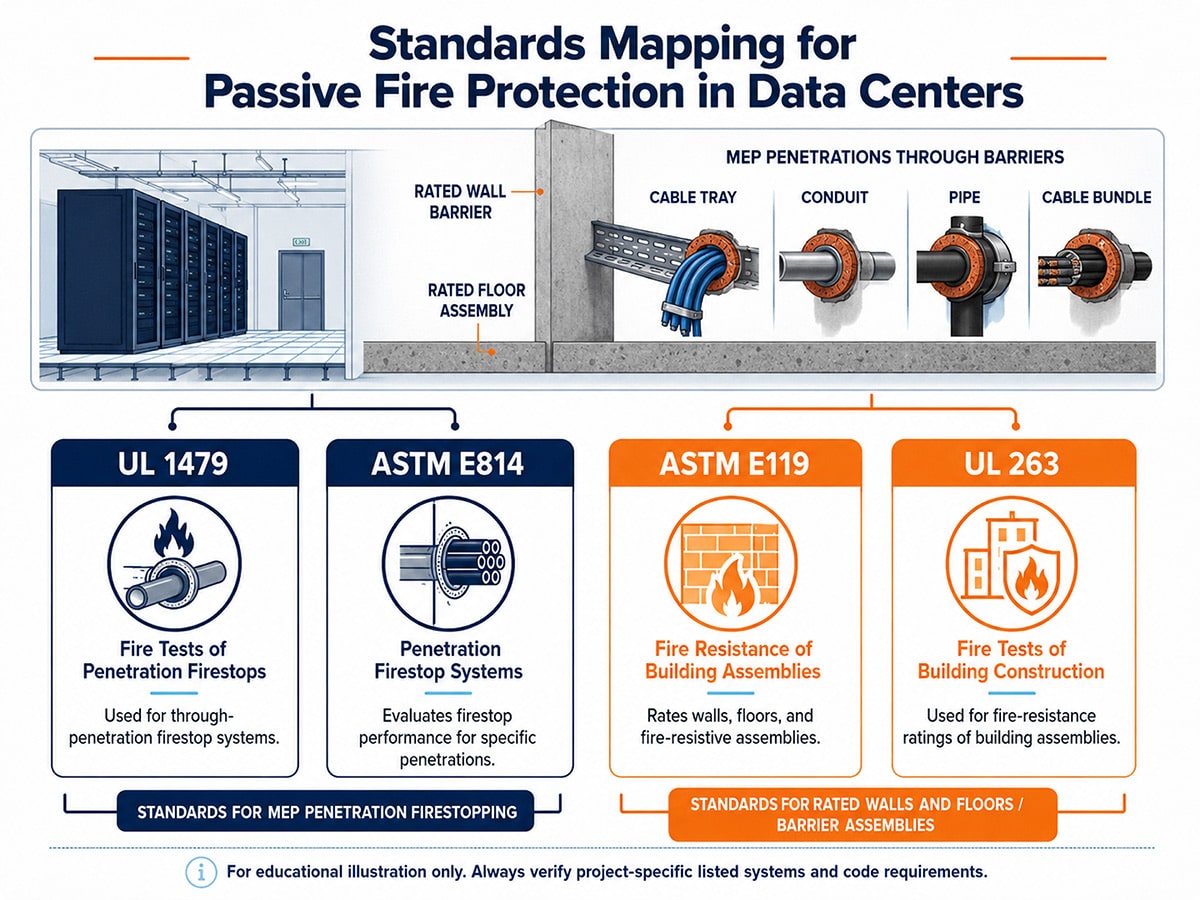
How key fire test standards map to penetrations and rated barriers in data centers.
Engineering Mitigation and Solution Strategies
Engineering mitigation is about controlling pathways, not predicting every initiating failure.
Start with Compartmentation and Fire Partitioning
Define the rated boundary early:
- Minimize penetrations through critical barriers.
- Standardize penetrant types across zones.
- Avoid routing that forces late penetrations in congested areas.
Treat Firestopping as a System Selection Workflow
Best practice is not “pick a firestop,” it is “match a listed system.” A practical workflow that holds up across projects includes barrier classification, penetrant classification, geometry lock, listed system match, and change management planning.
Use Strategies That Reduce Variability
Field-applied sealants can be effective, but they are vulnerable to access issues and installer variation. For repeated OEM penetration conditions, preformed components and integrated device approaches can improve repeatability, provided the final configuration matches therelevant listed system requirements.
If your product creates repeated penetration conditions, request a design-stage review to map your geometry to a UL 1479 / ASTM E814 compatible path before tooling locks. See Pyrophobic’s engineering perspective on integrated penetration devices here: Designing Integrated Firestop Devices for MEP Penetrations.

Comparison Tables
Material Test Versus System Test
| What is Evaluated | Common Standard | What it Tells You | What it Does Not Tell You |
|---|---|---|---|
| Through-penetration firestop performance. | UL 1479 / ASTM E814 | Whether a specific configuration performs as tested. | That a similar field condition is compliant without a listing match. |
| Fire resistance of walls and floors. | ASTM E119 / UL 263 | Whether a barrier assembly achieves an hourly rating. | That penetrations preserve the rating without tested firestop systems. |
| Flammability screening of plastics. | UL 94 | Preliminary flammability behavior of plastics. | Fire resistance rating or firestop compliance. |
Firestopping Approaches for MEP Penetrations
| Approach | Where it Excels | Trade-offs OEMs Must Manage |
|---|---|---|
| Field-applied sealants, wraps, and putties. | Flexible across many penetrant types. | Installation variability and inspection burden. |
| Preformed and molded intumescent penetration seals. | Repeatable geometry for standard details. | Must match listing constraints, avoid universal-fit assumptions. |
| Integrated OEM firestop devices. | Predictability for repeated penetration conditions. | Requires early engineering and configuration control. |
| Fire-rated poke-through devices. | Purpose-built for wiring pathways through rated floors. | Assembly and installation details must be followed precisely. |
Practical Application for OEM Engineers
This section is designed as decision support you can use in design reviews and supplier qualification.
What OEM Engineers Must Evaluate:
- Assembly rating basis: Confirm the rated wall or floor requirement.
- Penetrant taxonomy: Define tray, conduit, pipe, sleeve, and mixed conditions.
- Geometry control: Verify annular space and tolerance stack-up in real builds.
- Movement exposure: Confirm whether joint-system considerations apply.
- Smoke objective: Decide whether leakage control is a performance requirement.
- Re-entry strategy: Define how future adds will be handled without breaking compliance.
Common Mistakes OEM Teams Make in Data Centers
- Confusing UL 94 with UL 1479.
- Using joint-only systems at penetrations.
- Ignoring configuration control.
- Treating firestop as a late closeout item.
- Underestimating add and change erosion.
Key Technical Questions to Ask Suppliers
- Which listed systems match our exact condition?
- What geometry limits apply?
- What installation instructions govern acceptance?
- How will future re-entry be handled?
- How will inspection labeling be supported?
Pyrophobic’s Approach and Solutions
Pyrophobic delivers engineered passive fire protection materials that can be integrated into OEM components, helping improve repeatability for high-volume penetration conditions.
- SafePassage: A fire-rated poke-through solution for floor and deck pathways used in electrified assemblies.
- Integrated penetration devices: An engineering approach that moves variability from field installation toward controlled OEM geometry, while still requiring adherence to listed system constraints.
- Tests and certifications overview: At Pyrophobic Systems, we are dedicated to delivering advanced fire-resistant materials that help protect lives whether at home, at work, or in transit. Our commitment to safety and innovation is reflected in the rigorous testing and certification processes our products undergo.

Conclusion: Design for Containment, Not Just Cooling
AI infrastructure pushes thermal density and increases pathway complexity. That makes containment pathways, especially firestopping for MEP penetrations, a design requirement that belongs early in the OEM workflow. UL 1479 / ASTM E814 tested firestop systems and disciplined compartmentation are what keep a localized incident from becoming a facility-wide smoke event.
Key Takeaways
- Passive fire protection for data centers is the non-negotiable backstop: It keeps working without power, sensors, pumps, or operator action, which is exactly when cooling failures become most dangerous.
- AI rack density increases both heat risk and penetration count: More liquid cooling interfaces and more MEP routing typically means more openings through rated walls and floors, and each one can become a smoke and fire pathway if unmanaged.
- Penetrations are the most common weak point in compartmentation fire barriers: A single noncompliant opening can bypass an otherwise fire-rated assembly and allow smoke and heat migration beyond the origin zone.
- Firestopping is a tested system, not a generic material choice: Compliance depends on matching the exact field condition to a UL 1479 / ASTM E814 tested and listed firestop system, then installing it exactly as specified.
- Do not confuse material flammability with firestop compliance: UL 94 screens plastic flammability for parts, it does not establish a fire-resistance rating or a penetration firestop system listing.
- Rated barriers and firestop systems must align: ASTM E119 / UL 263 rate the wall or floor assembly, and UL 1479 / ASTM E814 validate that penetrations preserve the rating when built as tested.
- Smoke containment can be an uptime issue, not just a life safety issue: In data centers, smoke migration can trigger cascading shutdowns and complicate response even without widespread flame spread.
- Design-stage standardization reduces inspection failures and rework: Fewer penetration types, controlled geometry, clear labeling, and a repeatable submittal workflow materially improve acceptance and long-term maintainability.
- Plan for adds and changes from day one: Data centers evolve constantly, and passive fire protection must be designed so re-entry and modifications stay within the listed system constraints.
- Integrated penetration devices can reduce variability for repeated OEM conditions: When engineered to the right listing path, preformed or device-integrated intumescent solutions can improve consistency versus purely field-applied approaches.

Frequently Asked Questions
1) What is passive fire protection for data centers?
Passive fire protection for data centers is the built-in combination of rated barriers and tested firestop systems that contain fire and smoke without activation or power.
2) Why does AI cooling failure increase passive fire protection importance?
Cooling failures can increase thermal stress and the likelihood of smoke generation during electrical faults, making containment at penetrations and boundaries more important.
3) What is UL 1479 used for?
UL 1479 is used to evaluate penetration firestop systems intended for openings in fire-resistive assemblies.
4) What is ASTM E814 used for?
ASTM E814 evaluates penetration firestop system performance for specific configurations, and it supports rating and compliance decisions.
5) Is UL 94 enough for firestopping decisions?
No. UL 94 screens plastic flammability, it does not create a fire resistance rating or a firestop system listing.
6) What is the difference between a joint system and a penetration system?
Joint systems are evaluated under UL 2079 or ASTM E1966, penetration systems are evaluated under UL 1479 or ASTM E814.
7) Why is smoke containment critical in data centers?
Smoke migration can cause operational shutdowns and compromise tenability and response, even without widespread flame spread.
8) What does firestopping for MEP penetrations require?
It requires matching the exact condition to a tested and listed system, then installing per the listing documentation.
9) What is a fire-rated poke-through device used for?
It preserves the fire resistance of a rated floor or deck assembly while allowing wiring or similar services to pass through.
10) How should OEMs plan for frequent adds and changes?
Standardize penetration types, define re-entry strategy, and implement inspection-friendly labeling and documentation.
11) What is AI Data Center cooling?
AI data center cooling refers to the specialized thermal management systems designed to remove the intense heat produced by high-density artificial intelligence servers.
12) How do I protect my data center from fire?
Protecting a data center from fire requires a layered strategy that combines passive and active systems. Start with compartmentation fire barriers using fire-rated walls and floors, then protect every opening with UL 1479/ASTM E814 tested firestop systems so smoke and flame cannot travel through MEP penetrations. Add detection and suppression per your facility standard, and maintain strict change control so future cabling and piping additions do not break compliance. For IT environments, align the overall approach with NFPA 75 guidance for protecting IT equipment areas from fire and associated effects like smoke and heat.
13) What fire protection do AI servers need?
AI servers typically need more than “standard server room” assumptions because higher power density can reduce thermal margin during cooling faults. From a building interface perspective, the key requirement is ensuring the AI hall stays a controlled compartment: use passive fire protection systems to maintain rated boundaries, and ensure all cable trays, conduits, coolant piping, and controls crossing the boundary are sealed with listed firestop systems that match the exact configuration. On the equipment side, engineers often evaluate polymer selection and flammability screening such as UL 94, but that should be treated as a materials screen, not as a substitute for building firestop compliance or assembly fire-resistance ratings.
14) Which firestop systems work for data centers?
The firestop systems that work for data centers are the ones that are tested and listed for your exact conditions, including the rated wall or floor construction, the penetrant types, the opening size, and the annular space geometry. In practice, most compliance pathways for penetrations rely on UL 1479 and ASTM E814 tested systems, tied back to rated assemblies evaluated under ASTM E119 or UL 263. For data centers, prioritize systems that support high cable density conditions and that can be inspected and documented easily, because adds and changes are frequent. If re-entry is expected, confirm the listing details and maintenance approach so modifications can remain compliant over time.