
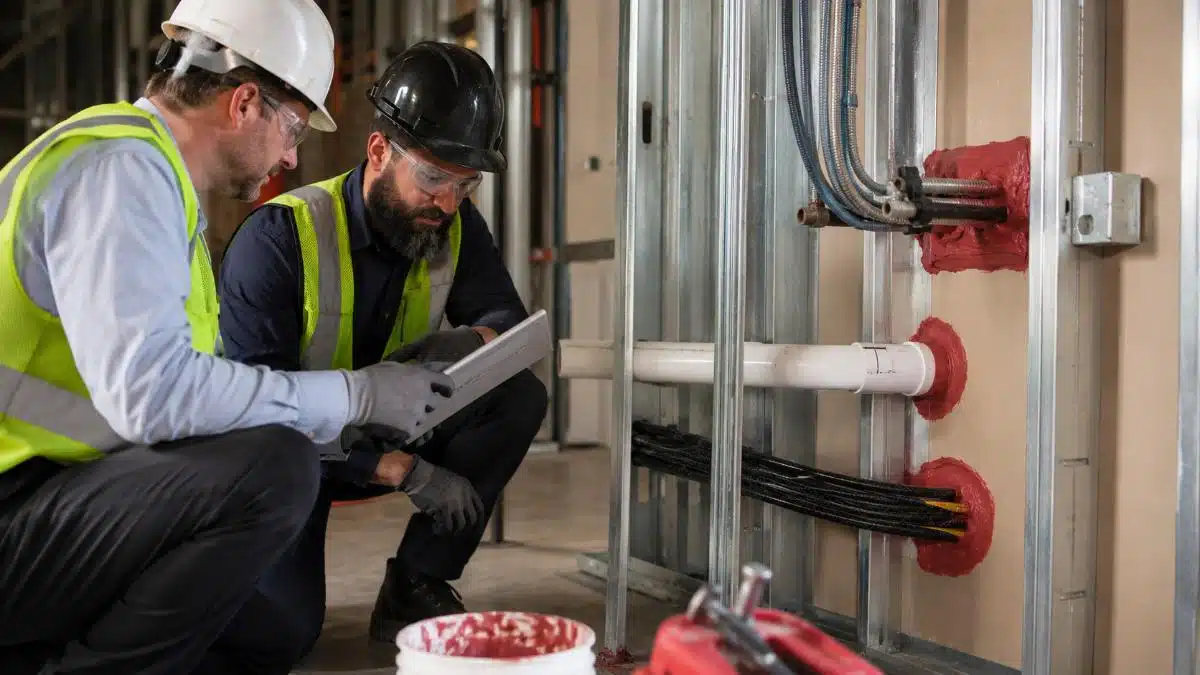
Introduction: Firestop Submittals Are a Project Management Risk
Firestop submittals are one of the quietest sources of construction rework. They rarely attract attention during early design, but when they are incomplete, unclear, or mismatched to field conditions, they can delay approvals, disrupt the broader construction schedule, trigger costly reinstallations, and create uncertainty around life safety compliance.
A firestop submittal is the documentation package used to show that a firestop material, device, or system is appropriate for a specific opening, penetration, joint, wall, floor, ceiling, or deck condition. In North American construction, the submittal is not only paperwork. It is the link between design intent, tested performance, installation practice, inspection, and building code fire compliance.
For OEM engineers, this matters because many firestop problems begin long before the contractor installs the material. They begin when a component is designed without enough attention to the rated assembly, penetration geometry, certification path, or installation tolerance. By the time the issue appears in the field, the project team may already be dealing with rejected submittals, change orders, schedule pressure, and rework.
The challenge is especially relevant in Data Centers, healthcare facilities, multifamily construction, commercial buildings, industrial facilities, and energy storage projects. These buildings contain dense electrical and mechanical infrastructure, many rated barriers, and a high volume of penetrations. Every cable, conduit, pipe, sleeve, box, or poke-through device that passes through a rated assembly can become a compliance checkpoint.
For OEM engineers, Architects, Firestop Engineers, or General Contractors (GC) focused on passive fire protection, the practical question is not only, “Does this material resist fire?” The better question is, “Can this design be documented, submitted, reviewed, installed, inspected, and maintained without unnecessary friction?”
That is where pre-engineered, NRTL listed, and clearly documented firestop materials can reduce construction rework. They help move firestop compliance from a late-stage jobsite problem into an earlier engineering decision.
Why Firestop Submittals Matter to Construction Project Management
Firestop submittals directly affect construction project management because they sit at the intersection of design coordination, procurement, installation, inspection, and approval. When the firestop path is unclear, project teams lose time trying to reconcile drawings, specifications, listed systems, supplier data, and field conditions.
A delayed firestop submittal can affect multiple project activities:
- It can delay wall closure, ceiling closure, or floor completion.
- It can interrupt inspection sequencing.
- It can create conflicts between electrical, mechanical, architectural, and life safety teams.
- It can force installers to remove and replace materials.
- It can require engineering judgments or revised documentation.
- It can create uncertainty for the authority having jurisdiction.
- It can increase administrative workload for construction managers and project engineers.
This is why the firestop submittal process should not be treated as a final administrative step. It should be treated as a construction risk control point.
For OEMs, this creates a clear opportunity. Products that arrive with defined geometry, tested use conditions, clear installation requirements, and practical documentation can reduce ambiguity for the construction team. That does not eliminate the need for project review, but it can make the review faster, cleaner, and more defensible.
Industry Context and Root Causes
Firestop rework usually happens in the field, but the root cause is often upstream. It can begin during product design, specification writing, coordination, or submittal preparation.
Firestop systems are specific. They depend on the rated assembly, penetration item, opening size, annular space, material placement, installation depth, and tested configuration. A product that performs well in one assembly may not be acceptable in another assembly unless the listing, certification, or approved engineering path supports that condition.
Common root causes include:
- Firestop details are selected after penetration layouts have already been fixed.
- Penetration sizes change after the original firestop submittal has been approved.
- Generic firestop language is used instead of assembly-specific documentation.
- Product data sheets are submitted without matching listed systems.
- Installers assume one firestop material applies to all field conditions.
- Annular space, wall type, floor type, sleeve material, and penetrating item size are not verified.
- OEM supplied components are not integrated into the project’s firestop documentation strategy.
- Field tolerances are not considered during product design.
- Drawings show the penetration, but not the tested firestop condition.
- Improper installation in the field. Caulks and paints need to be applied properly and are subject to rework if they fail inspection.
- The submittal package does not clearly explain what is inside and outside the approved use.
The issue is not only material performance. It is documentation performance, installation performance, and inspection performance.
Why Late Firestop Decisions Create Rework
Firestop is often coordinated after architectural, structural, electrical, and mechanical decisions are already locked. That sequence creates risk because listed firestop systems are not infinitely flexible.
A listed system may define the construction type, opening size, penetrating item, fill material, backing material, installation depth, exposed side, and allowed service configuration. If the field condition does not match, the project team may need to find another listed system, request an engineering judgment, modify the opening, replace the material, or reinstall the firestop.
Each option consumes time. Each option also creates a documentation trail that must be reviewed and accepted.
OEMs can reduce this friction by designing components that make the firestop function repeatable. Examples include molded intumescent parts, pre-formed inserts, electrical box fire gasket components, firestop-ready sleeves, and integrated poke-through fire protection assemblies.
Safety, Performance, and Compliance Risks

Firestop submittal failures create more than project delays. They can affect the integrity of smoke and fire containment in the completed building.
A fire-resistance-rated wall, floor, ceiling, or deck assembly performs as intended only when penetrations and openings are protected by compatible firestop systems. If an opening is left unprotected, incorrectly sealed, or sealed with a material outside its tested use, fire, heat, smoke, and hot gases may move through a barrier faster than expected.
For OEM engineers, the consequences can be grouped into five categories:
| Risk Category | What Can Go Wrong | OEM Relevance |
|---|---|---|
| Safety Risk | Fire, smoke, or hot gases may pass through rated barriers. | OEM products may become part of a life safety boundary. Material geometry, expansion, thickness, and installation details matter. |
| Performance Risk | A product may not match the tested system conditions. | Poor performance in testing or field use can compromise safety ratings. |
| Compliance Risk | Submittals may be rejected by consultants, inspectors, or AHJs. | Poor documentation can slow product acceptance and field adoption. |
| Business Risk | Rework, schedule delays, and change orders may increase project cost. | OEMs that simplify documentation can create practical value for project teams. |
| Liability Risk | Unsupported substitutions may be challenged after an incident. | Clear listings, limitations, and installation instructions reduce ambiguity. |
These risks are especially important in buildings with complex electrical infrastructure. Data Centers depend on compartmentation, smoke control, electrical continuity, and uptime. Energy storage fire safety adds additional complexity where lithium-ion battery fire protection, thermal runaway mitigation, battery module separation, and battery module fire barrier strategies may interface with rooms, enclosures, walls, penetrations, and service pathways.
This does not mean every firestop product is a battery safety product. It means modern facilities often combine construction firestopping, electrical infrastructure, and energy storage risk in the same design environment. OEM engineers need to understand where one compliance path ends and another begins.
Standards, Testing, and Regulatory Frameworks
Firestop standards define how assemblies are tested, rated, classified, and documented. They do not replace project specifications, engineering judgment, or authority having jurisdiction approval, but they provide the technical basis for many firestop submittals.
For OEM engineers, the key lesson is simple: standards must be connected to the actual application. A material property is not the same as an assembly rating. A plastic flammability classification is not the same as a penetration firestop listing. A battery fire propagation test is not the same as a building firestop test.
| Application | Relevant Standard | What It Evaluates | Why OEMs Should Care |
|---|---|---|---|
| Through-penetration firestop systems. | UL 1479 and ASTM E814. | Firestop performance through fire-rated walls and floors, including flame passage and temperature rise. | OEM components used around conduits, cables, sleeves, or devices must align with listed system limits. |
| Canadian firestop systems. | CAN/ULC-S115. | Firestop systems for openings and penetrations in fire-resistance-rated assemblies. | Canadian projects often require ULC recognized documentation and ratings. |
| Fire-resistance-rated assemblies. | UL 263 and ASTM E119. | Fire endurance of building construction assemblies such as walls, floors, columns, beams, and ceilings. | OEM products connected to rated decks, ceilings, or walls must not compromise the assembly rating. |
| Ceiling and floor deck assembly resistance. | ASTM E119 and UL 263. | Time-based fire exposure performance of construction assemblies. | Poke-through and electrified deck products must coordinate with assembly-level fire resistance. |
| Plastic material flammability. | UL 94. | Horizontal and vertical burning behavior of polymeric materials. | Useful for material screening, but it does not replace assembly firestop testing. |
| Surface burning behavior. | ASTM E84. | Flame spread index and smoke developed index. | Helpful for certain building material classifications, but it is not the same as an ASTM fire resistance rating. |
| Battery energy storage fire propagation. | UL 9540A. | Thermal runaway fire propagation characteristics of battery energy storage systems. | Relevant when firestop, enclosure, room design, or containment strategy intersects with energy storage fire safety. |
| Certification verification. | OSHA NRTL program directories. | Independent testing, listing, labeling, and certification verification. | OEMs should confirm that listed products and systems match the intended use. |
Need help meeting fire safety standards, requirements or regulations?

Why “Listed” Does Not Mean “Universal”
A listed firestop system is specific. It describes the tested condition and the limits of use. It does not mean the product can be installed in any wall, floor, ceiling, or penetration.
A through-penetration firestop system may depend on the exact floor type, wall type, penetrating item, pipe or conduit diameter, opening size, annular space, insulation, packing material, sealant depth, and exposed side. Changing one of those variables may move the field condition outside the listed design.
This is why firestop submittals must connect three things clearly:
- The actual construction condition.
- The listed firestop system.
- The installation method that will be used in the field.
When one of these elements is missing, rework risk increases.
Engineering Mitigation and Solution Strategies
Reducing firestop submittal rework requires a shift from reactive documentation to design-integrated compliance.
OEM engineers can support that shift by considering firestop performance early in the product development process. The goal is not to make every OEM a code consultant. The goal is to reduce ambiguity for the design team, installer, inspector, and authority having jurisdiction.
Material-Based Strategies
Material selection should consider fire performance, manufacturability, field installation, and documentation clarity.
- Intumescent firestop materials can expand when exposed to heat and help close openings or restrict passage around penetrations.
- Pre-formed firestop components can reduce variability compared with fully field-applied systems.
- Molded intumescent parts can control thickness, placement, geometry, and activation location.
- High-performance fire seals can support repeatable installation when the design is aligned with the listed use.
- Composite materials can combine mechanical stability with passive fire protection performance when properly tested.
- Intumescent battery materials can support thermal runaway mitigation when they are designed and tested for the specific battery application.
OEMs should be careful not to mix compliance paths. UL 9540A compliance language for energy storage fire safety should not be used as a substitute for UL fire-test requirements for building penetrations. Battery module fire barrier design and construction firestopping may both be relevant in a project, but they are not the same technical problem.
Design-Level Strategies
Design-level mitigation focuses on reducing field variation.
- Define the rated assembly interface early.
- Standardize opening sizes and penetration geometry where possible.
- Avoid relying on installer interpretation for critical material placement.
- Use components that guide correct installation depth and orientation.
- Confirm whether the firestop approach is compatible with field tolerances.
- Document what conditions are inside and outside the approved use.
- Coordinate the product design with the intended listed system before launch.
- Provide visual installation instructions that match the tested condition.
For poke-through devices, this can mean designing the firestop function into the device instead of leaving the entire protection strategy to a field-applied material. For an electrical box fire gasket, this can mean ensuring that gasket thickness, box size, wall type, fastener placement, and listing conditions are clear in the submittal.
System-Level Protection Concepts
System-level protection connects firestop decisions to the larger building strategy.
- Firestop systems should support smoke and fire containment across rated barriers.
- Wall cavity fire protection should be considered where services, boxes, and concealed voids create hidden pathways.
- Firestop materials should be coordinated with electrical, mechanical, structural, and architectural constraints.
- Data Centers should align firestopping for MEP penetrations with uptime, inspection, and maintenance requirements.
- Energy storage rooms should coordinate battery module fire barrier concepts with room separation, ventilation, suppression, and emergency response planning.
If your team is developing a fire-rated component, poke-through product, intumescent penetration seal, or passive fire protection material interface, contact Pyrophobic to discuss design constraints, listing objectives, and material integration options early in development.

Comparison Tables for Better OEM Decisions
Comparison tables help OEM engineers make practical decisions. They do not replace testing, listings, or project-specific review, but they clarify trade-offs.
Firestop Approach Comparison
| Approach | Strengths | Limitations | Best-Fit Use Case |
|---|---|---|---|
| Field-applied sealants. | Flexible for varied conditions and common on jobsites. | Installation quality depends on depth, backing, annular space, and installer control. | Non-standard openings where assembled systems do not fit the opening. |
| Mineral wool and sealant systems. | Widely used and adaptable. | Requires correct compression, packing depth, and sealant installation. | Larger openings, joints, and penetrations covered by specific listings. |
| Pre-formed plugs or blocks. | Can simplify installation and reduce material variability. | May have geometry limits and still require listed-system alignment. | Repetitive openings controlled with fixed dimensions. |
| Molded intumescent components. | Controls material placement, thickness, and expansion location. | Requires product-specific design, tooling, and testing strategy. | OEM integrated firestop devices and repeatable manufactured assemblies. |
| Integrated firestop devices. | Can reduce field decisions and simplify submittals. | Must be designed and listed for the intended assembly and penetration condition. | Poke-through products, floor boxes, sleeves, and factory integrated systems. |
| Engineering judgments. | Can address field conditions without a directly matching listed system. | Requires technical basis and acceptance by the project authority. | Unique field conditions where no existing listed system applies. |
Material Comparison for OEM Design
| Material Type | Typical Function | Engineering Benefit | Important Limitation |
|---|---|---|---|
| Intumescent polymer. | Expands under heat to help close or protect an opening. | Can be molded or formed into controlled geometries. | Must be tested in the relevant assembly and application. |
| Elastomeric sealant. | Seals gaps and accommodates movement. | Useful for joints and penetrations when listed. | Field installation quality strongly affects performance. |
| Mineral wool. | Provides backing, insulation, and packing. | Common in many listed systems. | Compression and depth must match the listing. |
| Firestop mortar. | Fills large openings and rigid penetrations. | Durable for certain wall and floor conditions. | Less suitable where movement, future access, or complex services are expected. |
| Composite fire barrier. | Combines thermal, intumescent, or structural functions. | Useful for OEM integrated components and repeatable designs. | Requires careful certification planning and documented limits. |
| Aerogel, mica, or ceramic barriers. | Provides thermal insulation or separation. | Useful in battery or module separation and high-temperature environments. | May not provide expansion or sealing unless designed with other elements. |
Compliance Path Comparison
| Compliance Path | What It Provides | What It Does Not Provide | OEM Takeaway |
|---|---|---|---|
| Listed firestop system. | Tested configuration with defined use conditions. | Approval for every possible field variation. | Design products to fit repeatable listed conditions. |
| Product certification. | Evidence that a product component meets defined certification requirements. | Automatic acceptance in every assembly. | Confirm the product category and listing scope. |
| Engineering judgment. | Technical rationale for a condition not directly covered by a listing. | Universal approval or substitute for testing. | Use only when justified and accepted by the project authority. |
| Material data sheet. | Material properties and handling information. | Assembly-level firestop compliance. | Use as supporting information, not the primary compliance basis. |
| Installation instructions. | Required installation method and limitations. | Independent proof of fire resistance unless tied to a listing. | Make instructions clear, visual, and aligned with tested conditions. |
Practical Application for OEM Engineers

OEM engineers can directly influence whether firestop submittals move quickly or create rework. The most useful decisions happen before product launch, before project specification, and before the first submittal package is assembled.
What OEM Engineers Must Evaluate
- Rated assembly type, including wall, floor, ceiling, deck, or floor-ceiling construction.
- Penetration type, including cable, conduit, pipe, sleeve, box, device, or mixed service.
- Opening geometry, including diameter, width, height, annular space, and tolerance.
- Firestop function, including flame blocking, temperature rise control, smoke control, or expansion.
- Applicable standard, including UL 1479, ASTM E814, CAN/ULC-S115, UL 263, or ASTM E119.
- Certification path, including listing, classification, engineering judgment, or project-specific review.
- Installation repeatability, including whether the design reduces field interpretation.
- Maintenance needs, including future cable changes, inspections, and replacement access.
- Documentation requirements, including what reviewers and inspectors need to approve the work.
- Supplier support, including technical data, drawings, installation guidance, and listing references.
Common Mistakes OEMs Make
- Treating a material rating as equivalent to a system rating.
- Assuming UL 94 plastic flammability is the same as firestop performance.
- Designing the mechanical product first and adding fire protection later.
- Providing product data without system listings or installation limits.
- Ignoring Canadian requirements when projects require CAN/ULC-S115 documentation.
- Using “fire-rated” language without identifying the tested assembly.
- Failing to explain what happens when the field condition changes.
- Overlooking how installers will verify correct placement onsite.
- Assuming a successful lab test automatically creates a scalable submittal strategy.
- Designing a component that performs technically but is difficult to inspect.
Key Technical Questions to Ask Suppliers
- What standard was the product, material, or system tested to.
- What rated assembly was used during testing.
- What are the allowed opening sizes, annular spaces, and penetration types.
- What installation depth, compression, orientation, or fastening is required.
- Is the product listed, classified, certified, or only tested.
- Is the listing searchable in a recognized certification database.
- What conditions require an engineering judgment.
- What documentation should be included in the submittal package.
- What tolerances are acceptable before the design falls outside the tested system.
- What similar conditions have already been reviewed, tested, or listed.
- What changes would require retesting or a new approval path.
- What support is available during design review or AHJ questions.
Design and Integration Considerations
Good firestop design is not only about passing a test. It is about making the tested condition practical to reproduce.
An OEM component should help the installer understand where the firestop material goes, how much is required, how the component aligns with the rated assembly, and what details must be preserved. If a design depends on an invisible or difficult-to-control field variable, the risk of rework increases.
For manufactured products, repeatability is an advantage. A molded intumescent component, pre-positioned gasket, or integrated insert can reduce variability compared with a field-only approach. The value is not only speed. The value is a clearer connection between engineering intent, submittal documentation, and final installation.
How Better Firestop Submittals Reduce Rework
A strong firestop submittal reduces rework because it helps reviewers and field teams answer the same core question: “Does this documented system match the actual condition?”
The best submittals are specific, visual, and traceable. They should identify the rated assembly, the penetration type, the tested system, the product or material, the installation method, the allowed tolerances, and the limitations. They should also show what happens when the field condition changes.
For OEM engineers, this means the product should support the submittal before the contractor ever submits it.
A better OEM firestop package may include:
- Product data sheets with clear application boundaries.
- Listed system references or certification documentation.
- Installation drawings that match the tested configuration.
- Dimensional tolerances for openings, sleeves, boxes, or devices.
- Visual instructions for field teams and inspectors.
- Notes explaining when technical review is required.
- Material safety and handling information.
- Product labels or markings that support field verification.
The more clearly the OEM controls the design interface, the easier it becomes for construction teams to submit, install, and inspect the product.
Pyrophobic’s Approach and Solutions
Pyrophobic Systems develops engineered passive fire protection materials for applications where fire performance, manufacturability, and compliance documentation must work together.
This approach is especially relevant for OEMs because many firestop challenges are not solved by selecting a commodity product at the end of the project. They are solved by integrating the right passive fire protection material into the product architecture early enough to support testing, listing, installation, and submittal clarity.
Relevant Pyrophobic solutions include:
- Intuplas, a patented intumescent fire safety polymer used in building construction fire protection applications.
- SafePassage, a UL listed poke-through solution for electrified deck systems that uses an intumescent composite molded to OEM specifications.
- FireBlok Gasket, Pyrophobic’s electrical box fire gasket solution for OEM integration in fire-rated wall applications.
- IntuLight, a fire-rated intumescent ring and gasket assembly for recessed lighting applications.
- Lithium Prevent, an intumescent thermoplastic technology developed for lithium-ion battery fire protection, battery module separation, thermal runaway mitigation, and battery module fire barrier applications.
- Pyrophobic data sheets, which provide technical documentation for product evaluation and engineering review.
- Pyrophobic product solutions, which include passive fire protection materials for building construction, energy storage, electric vehicle, and fire-rated component applications.
The Pyrophobic Systems commitment to safety and innovation is reflected in the rigorous testing and certification processes our products undergo.
For firestop submittals, the practical advantage of an engineered material is not that it eliminates the need for testing or documentation. It does not. The advantage is that it can be designed into repeatable components that support a clearer compliance path.
This is important for OEM engineers working on poke-through devices, firestopping for MEP penetrations, wall cavity fire protection, high-performance fire seals, intumescent penetration seal components, electrical box fire gasket designs, and intumescent firestop materials. The earlier the material strategy is aligned with the desired listing or test path, the lower the risk of redesign during submittal review.
Do you want a sample?

Frequently Asked Questions
What is a firestop submittal?
A firestop submittal is a documentation package used to show that a firestop system, product, or assembly is suitable for a specific rated construction condition. It typically includes product data, listed system details, installation instructions, safety information, and supporting certification documents.
Why do firestop submittals cause construction delays?
Firestop submittals cause delays when the submitted system does not match the actual field condition. Common issues include incorrect wall type, wrong penetration size, unsupported annular space, missing listing information, unclear installation requirements, or late design changes.
What does NRTL listed mean?
NRTL listed means a product or system has been evaluated and certified by a Nationally Recognized Testing Laboratory within the scope of applicable standards. For OEMs, the important step is confirming what the listing covers and whether it applies to the intended use.
Is a firestop material the same as a firestop system?
No. A firestop material is one part of a system. A firestop system includes the material, rated assembly, penetrating item, opening size, installation method, and tested configuration. Building code fire compliance depends on the system, not only the material.
What is the difference between UL 1479 and ASTM E814?
UL 1479 and ASTM E814 are both used for penetration firestop systems. They evaluate how firestop systems perform when openings or penetrations pass through fire-resistance-rated walls or floors. OEMs should confirm which standard and listing path applies to the project.
What is the difference between ASTM E119 and ASTM E814?
ASTM E119 evaluates the fire resistance of building construction assemblies such as walls, floors, and ceilings. ASTM E814 evaluates penetration firestop systems installed in those rated assemblies. OEM products may need to consider both when they interface with rated construction.
Does UL 94 prove that a product is acceptable for firestopping?
No. UL 94 evaluates burning behavior of plastic materials under specific test conditions. It is useful for material screening, but it does not prove that a product is acceptable as a firestop system in a rated wall, floor, ceiling, or deck assembly.
Why are pre-formed intumescent components useful for OEMs?
Pre-formed intumescent components can help control material placement, thickness, and geometry. This can reduce installation variability and make the submittal package easier to connect to the engineered design, provided the component is tested and documented for the intended use.
What should be included in a strong firestop submittal package?
A strong package should include the relevant listed system, product data sheet, installation instructions, certification documentation, safety data sheet, project-specific condition notes, and any approved engineering judgments. It should clearly connect the submitted system to the field condition.
How can OEM engineers reduce firestop rework?
OEM engineers can reduce rework by designing fire protection into the product early, confirming the applicable test standard, controlling critical geometry, documenting installation limits, and working with material suppliers before the first project submittal is prepared.
Are battery fire barriers and construction firestops the same thing?
No. Battery module fire barrier design is typically related to thermal runaway mitigation, lithium-ion battery fire protection, and cell-to-cell thermal runaway control. Construction firestopping focuses on protecting penetrations and openings in rated building assemblies. Some projects may involve both, but the standards and compliance paths differ.
Why does this matter in Data Centers?
Data Centers contain dense electrical infrastructure, critical uptime requirements, and many rated penetrations. Firestopping for MEP penetrations supports smoke and fire containment, helps maintain compartmentation, and reduces the risk that a localized fire condition becomes a broader facility disruption.
Can a firestop product reduce construction project management workload?
Yes, when the product is designed with clear documentation, repeatable installation, and a defined compliance path. A product cannot remove the need for review, but it can reduce the number of unresolved questions that slow submittals, inspections, and approvals.
When should OEMs involve a passive fire protection material supplier?
OEMs should involve a passive fire protection material supplier during concept design, not only after the mechanical design is complete. Early involvement helps align material selection, geometry, manufacturing method, test planning, and documentation before costly redesign is required.
Conclusion: Firestop Submittals Are an Engineering Efficiency Opportunity
Firestop submittals are often seen as a construction administration task, but OEM engineers should view them as a design quality checkpoint. When passive fire protection is considered late, projects are more likely to face rejected submittals, jobsite substitutions, rework, inspection delays, and unclear compliance responsibility.
The best outcomes come from connecting material selection, system testing, listing documentation, product geometry, installation instructions, and field realities early in the engineering process.
For OEMs, the takeaway is straightforward. Firestop performance is not only about choosing a material that reacts to heat. It is about designing a repeatable, documentable, testable solution that supports real construction workflows.
Looking for a solution to your fire safety challenge? We can help.

About Pyrophobic Systems
Pyrophobic Systems delivers engineered passive fire protection materials that help clients meet demanding fire safety requirements, backed by more than 35 years of proven performance.
Pyrophobic works with OEMs and technical teams across building construction, energy storage, electric vehicle, and fire-rated component applications. Its material technologies support practical integration, fire performance objectives, and compliance-driven product development.