
AI Passive Fire Protection OEMs, A Workflow to Shortlist Listed Systems, Speed Submittals, and Reduce Rework in Non-Residential Projects
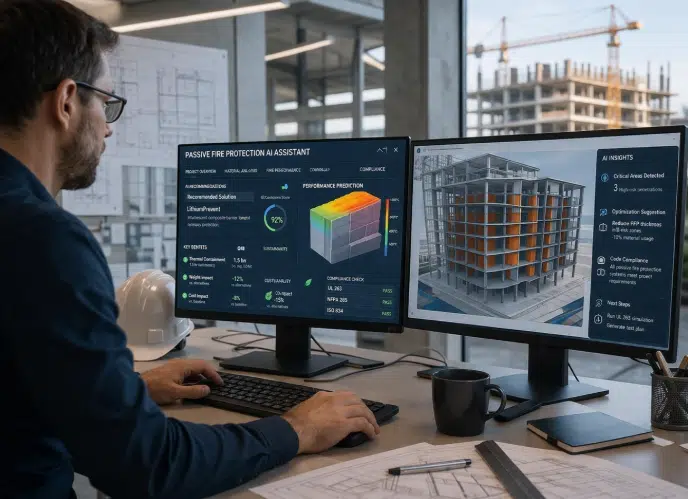
Passive fire protection AI software gives project teams a clearer view of fire performance, material optimisation, and compliance risks in modern construction.
In non-residential construction, projects rarely stall because people do not care about fire safety. Projects stall because teams cannot align fast enough on passive fire protection systems, the exact condition in the field, and the documentation needed for building code fire compliance.
If you support passive fire protection materials, you see the same pressure cycle repeatedly:
- A penetration condition changes late, cable bundles get larger, conduit counts increase, a sleeve type changes, or a poke through location moves.
- The rated wall or floor assembly is unclear, or the drawings conflict with the specification.
- The reviewer asks for proof that the firestop system matches the exact condition, including penetrant type, opening geometry, annular space, and required performance.
This is where passive fire protection becomes an OEM bottleneck. It is not a marketing problem, it is a workflow problem.
Your technical team wins when they can answer one question quickly, clearly, and defensibly:
Which listed system matches this exact condition, and can we prove it in a submittal that the reviewer will accept?
AI cannot replace UL fire test requirements, UL 1479 and ASTM E814 tested assemblies, ASTM E119 assembly ratings, or engineering judgment. AI can remove the friction that slows down passive fire protection workflows, including intake, classification, shortlisting, and submittal drafting.
Who this article is for
This guide is for passive fire protection OEMs serving non-residential building construction, including teams that design, support, and document:
- Firestop systems for buildings.
- Firestop materials for buildings, including intumescent firestop materials and high-performance fire seals.
- Compartmentation fire barriers and fire-rated construction materials.
- Smoke and fire containment solutions.
- Fire-resistant expansion joints and other passive fire protection systems used at movement conditions.
- Accessories for common details, such as electrical box fire gasket products, fire-rated recessed light cover solutions, wall cavity fire protection components, and fire-rated door core related assemblies.
It is written for product engineering, listings and approvals, technical services, and specification support teams that need repeatable execution, not high level definitions.
Why passive fire protection support becomes a scaling problem for OEM teams
Passive fire protection systems are condition specific. Two penetrations that look similar can require different systems if any of the following change:
- Host assembly type and thickness.
- Penetrant material and size, including mixed penetrants.
- Opening geometry, sleeve usage, and annular space.
- Required ASTM fire resistance rating, smoke leakage needs, and other project constraints.
- Access constraints and installation sequence.
This variability drives three predictable failure modes.
Condition variability creates rework
A “close enough” system match fails when annular space is outside the listed range, penetrant types do not match the tested system, or the host assembly is different than assumed.
Documentation demands more than product data
A reviewer does not approve a product, they approve a system and an installation that matches the system parameters. That means submittals must tie the condition back to listed evidence and installation requirements.
Field constraints create gaps between paper and reality
Congested MEP routing, one side access, late changes, and value engineering substitutions push teams into improvisation. That is where building code firestop solution failures happen.
The standards that matter in daily passive fire protection workflows
You do not need a long standard overview to move faster. You need clarity on what reviewers and compliance processes actually require.
- ASTM E119, used for fire resistance rating of building assemblies, often referenced alongside UL 263.
- UL 1479 and ASTM E814 tested, used for through penetration firestop systems, often the backbone for firestopping for MEP penetrations.
- UL 2079 and ASTM E1966, used for fire-resistant expansion joints and related movement capable joint systems.
Practical takeaway, passive fire protection materials must be used within systems that match the condition, and the submittal should show that match in a way that supports building code fire compliance.

Where AI helps a passive fire protection OEM, and where it does not
AI is most valuable when it speeds up the work that is repetitive, unstructured, and error prone.
AI helps with structure and speed
- Extracting requirements from specifications, schedules, and emails.
- Classifying the condition, through penetration, membrane penetration, linear joint, perimeter condition.
- Identifying missing inputs early, before a submittal goes out.
- Drafting RFIs, narratives, installation checklists, and comparison tables.
- Organizing internal knowledge into repeatable playbooks.
AI does not replace compliance proof
- AI should not invent a listing, a system number, or a performance claim.
- AI should not assume host assemblies, annular space, or penetrant materials.
- Final selection still requires validation against the actual listing evidence and project requirements.
Use AI to accelerate the workflow, then use technical review to confirm the listed match.

AI helps passive fire protection teams organise specifications, drawings, schedules and standards into a structured checklist for earlier design-stage coordination and compliance planning.
The execution workflow OEM teams can standardize
Step 1, Standardize condition intake, then let AI fill the template
Most delays start with incomplete questions. Create a simple intake that forces completeness.
Host assembly
- Wall or floor type, rating, thickness, and reference from drawings or schedule.
Condition type
- Through penetration, membrane penetration, linear joint, perimeter condition.
Penetrants and opening
- Penetrant family, metal or plastic, cable bundle, conduit, pipe.
- Opening geometry, round core drilled, rectangular framed, sleeve type.
- Annular space minimum and maximum, if unknown, mark as unknown.
Constraints
- Access, one side or two sides.
- Serviceability, re entry needs for cable ads.
- Smoke and fire containment requirements, if specified.
- Environmental constraints, if specified.
Submittal needs
- Listing evidence requirement, installation detail requirement, inspection readiness.
How AI fits
Give AI the inbound email, marked up details, and relevant spec sections, then ask it to populate your intake fields and list what is missing. This reduces back and forth and keeps your team from recommending the wrong direction too early.
Step 2, Apply hard filters first, the rules that eliminate options
A reliable shortlist starts with the constraints that frequently invalidate systems.
Hard filters include:
- Host assembly type and rating.
- Penetrant combustibility, metal versus plastic penetrants.
- Opening geometry and annular space range.
- Movement requirements for joints and perimeter conditions.
- Access constraints that limit packing, backing, or installation sequence.
AI can highlight which filters are known, which are unknown, and which unknowns block selection.
Step 3, Shortlist systems by condition family, not by product preference
In passive fire protection systems, the goal is not to pick a product first, it is to match a condition to a listed system approach.
A practical shortlisting model for firestop systems for buildings includes these families:
- Intumescent penetration seal approaches, often relevant for combustible penetrants or where expansion helps maintain closure.
- Elastomeric and sealant based approaches, often relevant where flexibility matters and installation is straightforward.
- Device based approaches, sleeves, collars, wraps, modular systems, and other high-performance fire seals that improve repeatability.
- Membrane penetration approaches, including details around electrical box fire gasket use cases and protected openings.
- Joint system approaches, fire-resistant expansion joints, head of wall, slab edge, and other movement conditions.
AI can draft a shortlist narrative that explains why each family might fit, and why it might fail, based on the intake fields. Your team then validates against the actual listing criteria.
Step 4, Catch missing data before it becomes rework
The highest return use of AI is gap detection. Submittals get rejected because the file does not prove the match.
Typical missing items:
- Host assembly ID or construction type.
- Annular space values, opening size and penetrant diameters.
- Confirmation of mixed penetrants, insulation, jacketing, or sleeves.
- Identification of joint versus penetration conditions.
- Evidence that the proposed solution aligns with UL fire test requirements for that condition.
Use AI to produce a clear “missing inputs” list and an RFI draft that asks for only what is needed.
Step 5, Draft approval ready submittals faster, then validate
Reviewers respond well to structure. A strong submittal for passive fire protection materials includes:
- Condition summary, host assembly, rating, penetrant type, opening geometry.
- System match statement, tied to the listed evidence and parameters.
- Installation notes, packing depth, backing requirements, thicknesses, and sequencing constraints.
- Contingencies, what must be confirmed in the field for the system to remain valid.
- Inspection checklist, what the installer and inspector should verify.
AI can draft these sections consistently, especially when your organization supports many similar requests across multiple projects.
OEM scenarios that benefit from an AI supported workflow
Scenario 1, Firestopping for MEP penetrations in congested risers
Dense conduit banks and cable bundles trigger frequent annular space issues and mixed penetrant questions. AI helps by structuring the intake and flagging which details are missing before a recommendation is made.
Scenario 2, Poke through coordination in floors
A poke through detail often arrives with incomplete assembly information or unclear opening geometry. AI helps identify missing floor assembly rating references, penetrant grouping, and required documentation for building code fire compliance.
Scenario 3, Wall cavity fire protection and device penetrations
Recessed fixtures and electrical boxes can create repeated membrane penetration questions. AI helps classify the condition and draft consistent support language for fire-rated recessed light cover solutions and electrical box fire gasket use cases, while maintaining a clear boundary between general guidance and listed system requirements.
Scenario 4, Fire partitioning for commercial buildings and compartmentation fire barriers
Projects often have compartmentation requirements across corridors, shafts, and tenant separations. AI helps extract passive fire protection system requirements from specs, then organize them into a coordination checklist that supports smoke and fire containment.
Scenario 5, Fire-resistant expansion joints and perimeter conditions
Movement conditions require joint systems, not penetration fixes. AI helps flag movement language in the specs and drafts the questions needed to confirm movement capability requirements before submittals are assembled.
Build a reusable condition library that scales your support
The biggest long term win is not a chatbot. It is a library that mirrors real workflows.
A scalable internal library for passive fire protection systems should include:
- Common condition families, grouped by host assembly, penetrant type, opening geometry, and movement requirement.
- Preferred system approaches per family, with constraints and common failure points.
- Submittal templates that map directly to intake fields.
- Installation checklists and inspection notes that reduce field mistakes.
- A “do not recommend” list based on repeat failure patterns.
AI helps keep this library usable by making it searchable by real condition language, not just product names.
Guardrails for using AI safely in passive fire protection
- AI organizes, drafts, and flags gaps, it does not certify compliance.
- Always validate recommendations against listing evidence and project requirements.
- Never allow AI to fill in missing condition inputs.
- Treat the intake template as a gate, if key inputs are missing, the output should be an RFI, not a recommendation.
This approach improves speed and consistency without increasing risk.
Conclusion, Faster passive fire protection execution without sacrificing compliance
Passive fire protection systems succeed when the condition is understood, the system match is defensible, and the submittal is structured for review. AI helps OEM teams scale that execution by turning unstructured inputs into structured decisions, then accelerating documentation for firestop systems for buildings, passive fire protection materials, and compartmentation fire barriers.
If you or your team supports high volume technical requests for firestop materials, intumescent firestop materials, intumescent penetration seal applications, or high-performance fire seals, an AI supported workflow can reduce back and forth, reduce rework, and improve building code fire compliance outcomes.

FAQ
What is passive fire protection?
Passive fire protection includes rated walls, floors, shafts, joints, penetrations, and related materials that contain fire, smoke, and hot gases through compartmentation and fire-resistance-rated construction.
How is passive fire protection different from active fire protection?
Passive protection is built into the assembly and works without activation. Active protection relies on systems like sprinklers and alarms that respond during a fire event.
Can AI approve a passive fire protection detail?
No. AI can organize requirements and draft documentation, but compliance still depends on tested/listed systems, project-specific conditions, human review, and AHJ acceptance.
When should an OEM team ask for outside technical support?
When conditions include mixed penetrants, unusual openings, movement conditions, incomplete assembly information, late design changes, or no obvious tested system match. These are where expert review prevents rework and delays.
Can AI select firestop materials automatically?
AI can shortlist options, but final selection still needs tested listings, assembly data, manufacturer guidance, and human review.
What are firestop materials?
Firestop materials are products used to protect penetrations, joints, and openings in fire-resistance-rated assemblies so the assembly can continue to limit the spread of fire and, in some conditions, smoke, heat, air, or water.